Vivetrics resources

Practical frameworks for operating Amazon Marketing Cloud.

Measurement quality depends on more than access to data. Teams also need clear definitions, appropriate methodology, reliable operating practices, and a path from analysis to action.

These resources document how Vivetrics approaches AMC measurement, audience strategy, and workflow design in practice.

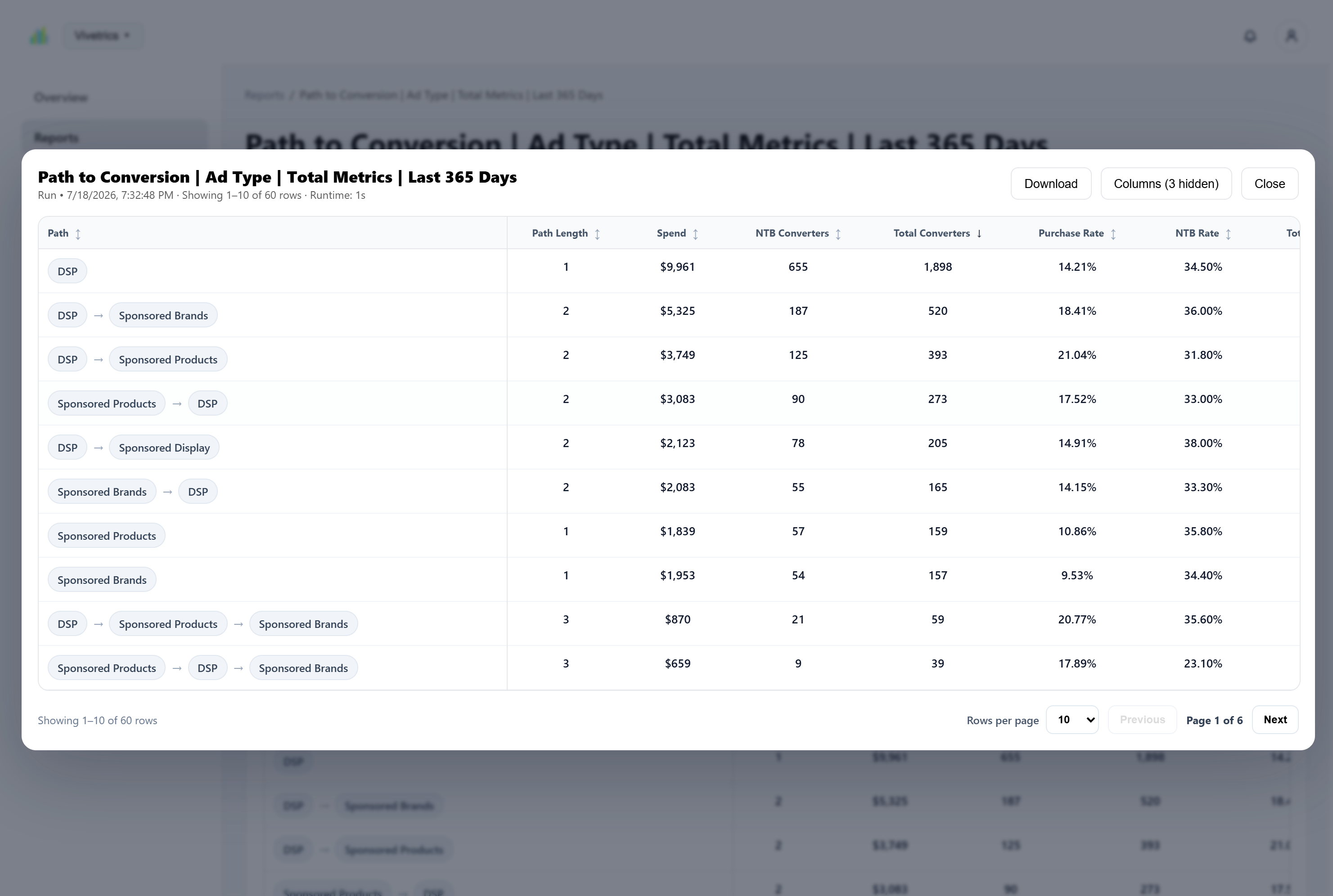
Measurement output
Vivetrics completed path-to-conversion report with report configuration, execution details, and output.
Operational context
Vivetrics mappings interface showing synchronized campaigns organized into reusable groups.
MeasureInterpretOperate
01Measurement frameworks

Answer business questions without losing analytical context.

AMC analysis should begin with the decision the team needs to make, then define the population, events, timing, scope, and comparison required to answer it responsibly.

01Customer journey

Path-to-conversion analysis

Evaluate how Amazon DSP and Sponsored Ads touchpoints combine before conversion instead of relying only on the final attributed interaction.

Questions this framework supports
  • Which paths account for the most converter and sales volume?
  • How concentrated is performance across the largest paths?
  • Where do multi-touch sequences materially influence outcomes?
02Channel interaction

Ad-type overlap

Compare users reached by individual ad types with users exposed across multiple channels to understand incremental reach and combined value.

Questions this framework supports
  • How much audience overlap exists between DSP and Sponsored Ads?
  • Which exposure groups generate the strongest purchase behavior?
  • Where is additional reach producing meaningful value?
03Retention

Lapsed purchaser analysis

Use repeat-purchase cadence and observed purchase behavior to identify reactivation, replenishment, and first-to-second purchase opportunities.

Questions this framework supports
  • How many repeat purchasers are currently lapsed?
  • Which products or product groups create the largest opportunity?
  • When should replenishment or winback messaging begin?
04Acquisition

New-to-brand interpretation

Read acquisition signals in context by considering volume, path composition, product mix, attribution source, and campaign role together.

Questions this framework supports
  • Which strategies contribute meaningful NTB volume?
  • Does a high NTB rate also have enough scale to matter?
  • Which paths support acquisition versus efficient harvesting?
Interpretation principles

Strong analysis is defined by how the result is framed.

01

Define the population first

Clarify the users, entities, products, exposures, and conversion events included before interpreting a result.

02

Separate volume from rate

A strong rate without meaningful reach or converter volume may not represent the largest business opportunity.

03

Keep time windows explicit

Lookback, attribution, purchase exclusion, advertiser time zone, and reporting availability all affect the answer.

04

Interpret roles, not only rankings

A path or tactic can support acquisition, consideration, efficiency, or conversion without needing to lead every metric.

From output to interpretation

A completed report should explain more than the table.

Vivetrics connects source reports to summaries, recommendations, and analytical visualizations so teams can move from raw AMC output toward a practical next decision.

  • Source report and data period remain visible
  • Executive readouts summarize the primary story
  • Recommended actions identify follow-up opportunities
  • Advanced views preserve analytical depth
Explore measurement use cases
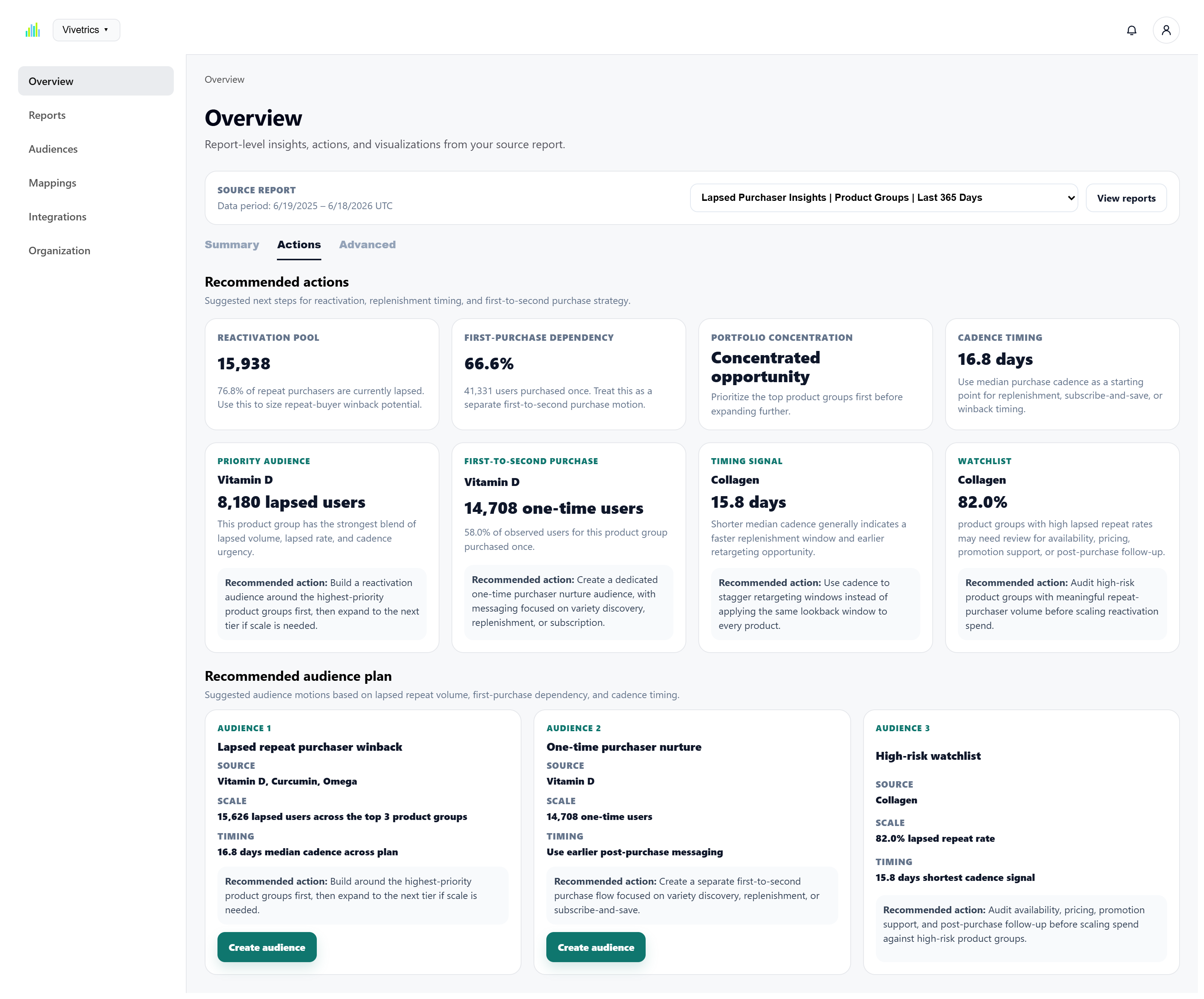
Interpretation and next action
Vivetrics Overview recommended actions and audience plans generated from a lapsed purchaser analysis.
02Audience strategy

Build audiences around observed behavior and a clear next action.

Audience quality comes from the relationship between source behavior, exclusions, recency, product scope, destination, and the media objective the audience is intended to support.

01Consideration → conversion

Non-purchasing PDP viewers

Retarget users who viewed selected products but did not purchase during the defined purchase-exclusion window.

Primary signalProduct or product grouping
02Exposure → conversion

Campaign-exposed non-purchasers

Reach users exposed to selected campaigns or ad groups who have not completed a qualifying purchase.

Primary signalCampaign or ad-group exposure
03Search intent → conversion

Search-term exposed non-purchasers

Build audiences from users exposed through selected customer search terms who did not purchase after their latest matching exposure.

Primary signalSearch exposure
04High intent → conversion

Cart abandoners

Re-engage users who added selected products to cart but did not complete a purchase within the exclusion window.

Primary signalCart behavior
05Retention → reactivation

Lapsed purchasers

Use product-level purchase cadence and recency to define replenishment and winback audiences more intentionally.

Primary signalPurchase behavior
06Existing behavior → next action

Cross-sell and sequencing

Identify users who purchased one product or experienced one media sequence without progressing to the next intended action.

Primary signalPurchase or exposure sequence
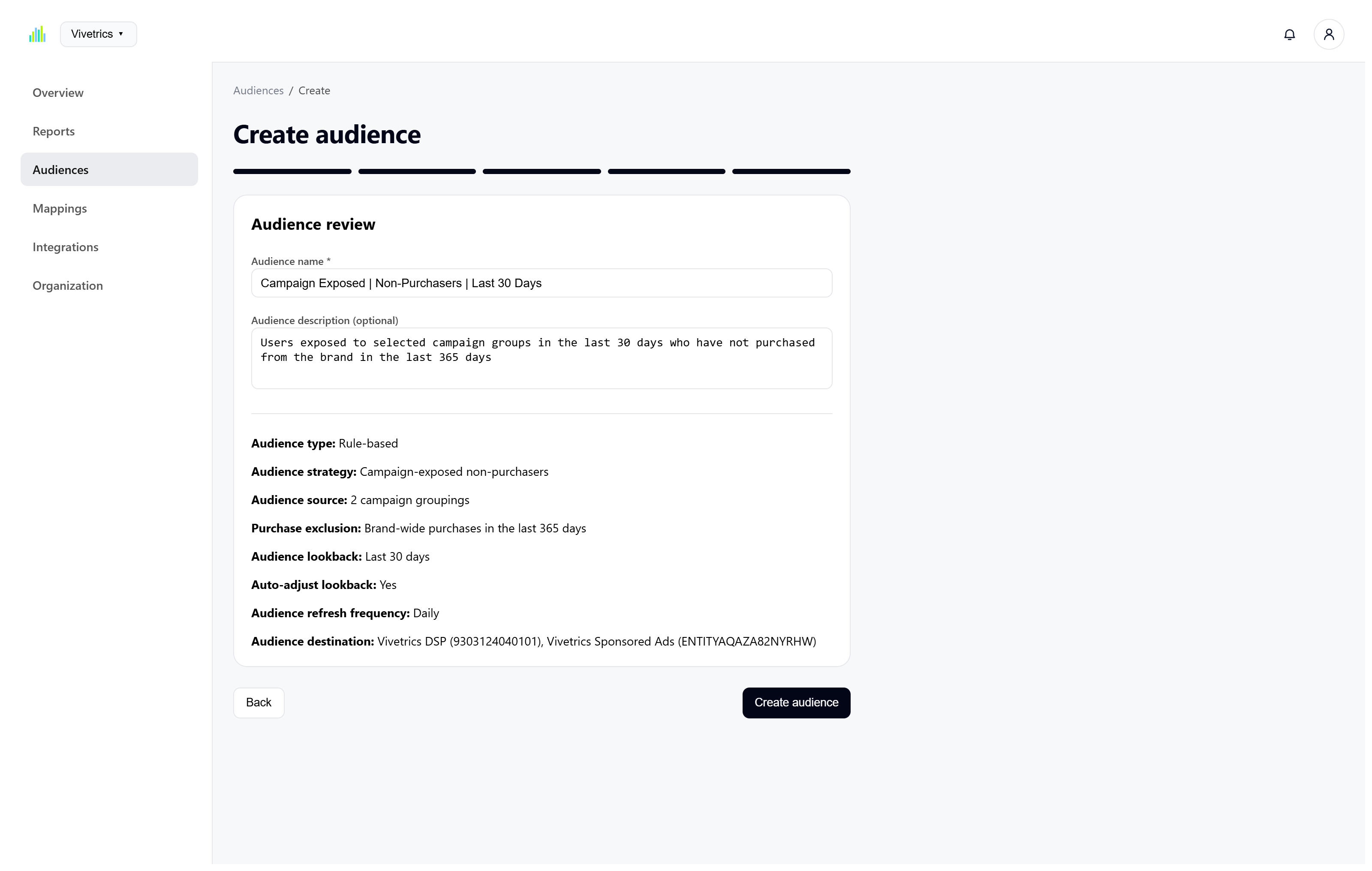
Audience configuration review
Vivetrics audience review showing audience source, purchase exclusion, lookback, refresh frequency, and destinations.
Audience methodology

Review the complete strategy before activation.

A usable AMC audience is not defined by its name alone. Its source, behavioral logic, purchase exclusions, lookback window, refresh frequency, and destination should be reviewed together.

01
Define intent

Clarify the audience strategy and media objective.

02
Select behavior

Choose the source entities, products, or actions that qualify a user.

03
Apply exclusions

Exclude users whose later behavior means they no longer qualify for the audience.

04
Confirm activation

Review recency, refresh timing, destination, and final audience configuration.

03AMC operations

Reliable insight depends on a reliable operating foundation.

Connection state, instance selection, included entities, storage, mappings, execution history, and date alignment are analytical inputs - not only administrative settings.

01
Connection

Confirm the Amazon user has the required access.

Authorization alone does not guarantee that AMC accounts, instances, Sponsored Ads entities, or DSP advertisers will be returned.

02
Instance

Select the AMC environment the workspace should use.

Reports, audiences, mappings, and included data sources should resolve from one explicitly selected AMC instance.

03
Storage

Verify where report output will be delivered.

Report execution is not complete until output storage is configured, verified, and available to the workspace.

04
Mappings

Turn platform entities into reusable business context.

Campaign, ad-group, and product groupings help reporting and audience workflows use consistent definitions.

05
Execution

Preserve configuration and run history.

Status, query configuration, runtime, row count, file size, prior runs, and output should remain reviewable after execution.

06
Time

Align UTC execution with source-specific reporting dates.

AMC execution windows, DSP advertiser time zones, Sponsored Ads entity time zones, and data availability can produce different date boundaries.

Reusable business context

Mappings connect Amazon entities to the way the business actually evaluates performance.

Raw campaign, ad-group, and product identifiers are necessary for execution, but they are rarely the language used for strategy and decision-making.

Reusable groupings make it possible to apply consistent funnel stages, product families, campaign roles, or other business definitions across reports and audiences.

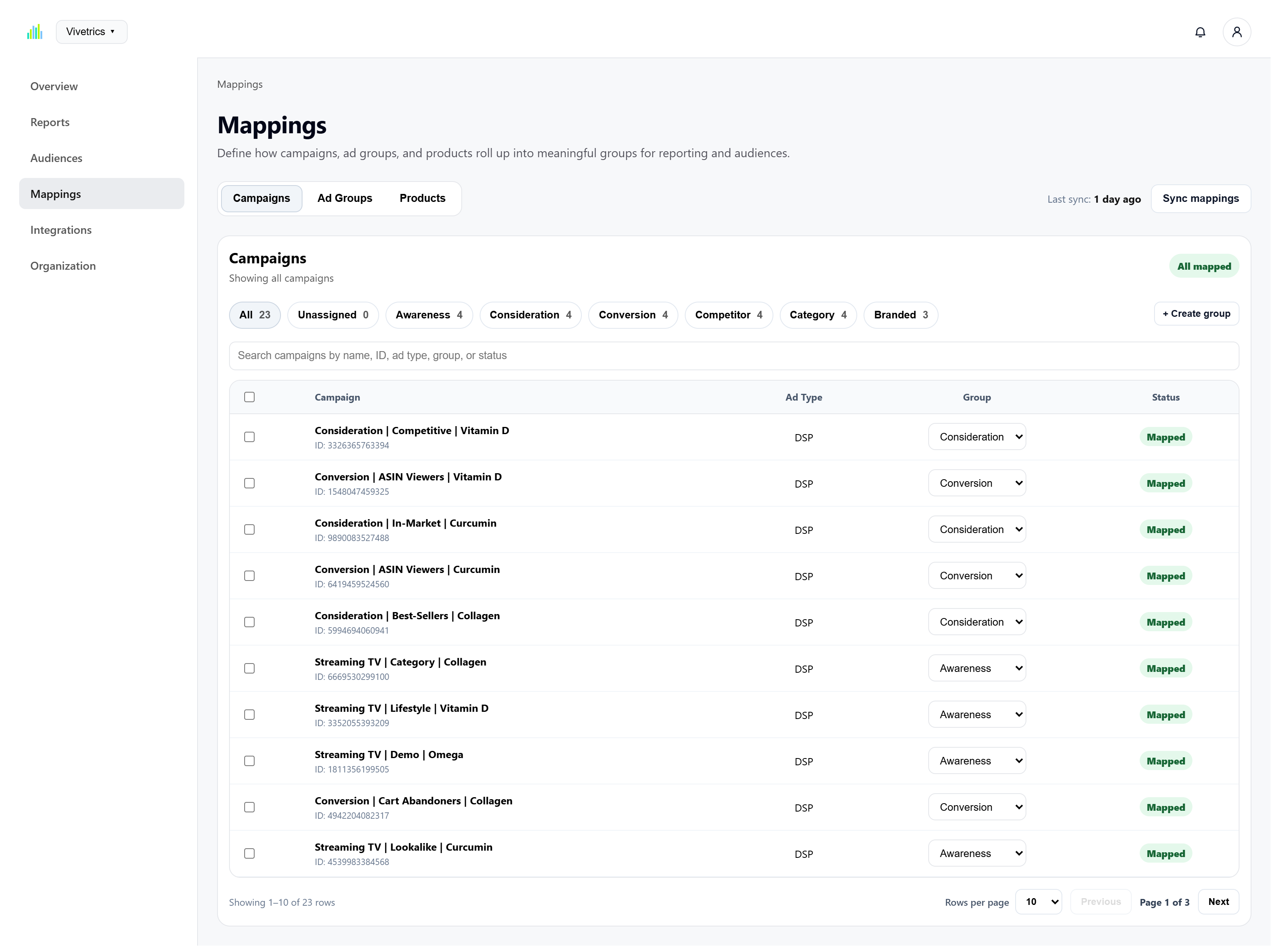
Semantic mappings
Vivetrics mappings page showing campaign groups, search, sync state, and mapped status.
Resource standards

Practical knowledge should make the work easier to defend.

Vivetrics resources are designed to document real decisions and operating considerations - not only describe platform features.

01

Applied

Each framework should connect to a real measurement, audience, or operating decision.

02

Explicit

Definitions, assumptions, windows, limitations, and source context should remain visible.

03

Reusable

The methodology should work across recurring reports, teams, and workspaces rather than one isolated analysis.

04

Actionable

The output should help a practitioner decide what to investigate, change, build, or activate next.

The goal is not to simplify AMC until its important details disappear. The goal is to make those details easier to apply, review, and reuse.

Resource direction

A growing reference for measurement, activation, and AMC operations.

As the Vivetrics platform and report library expand, this resource center can grow into deeper guides, methodology references, implementation notes, and product workflow documentation.

Measurement methodologyAudience designAMC date handlingData-source selectionMapping strategyOperational QA
Apply these frameworks

See how Vivetrics operationalizes AMC methodology.

Explore guided reporting, interpretation, mappings, execution, and audience workflows in a demo tailored to your team.